Showing posts with label psychology. Show all posts

30 March 2018

My View of Positive Psychology on Assessment and Personal Experience

Positive psychology, as a practice, discipline and developing science had been in the development of psychology, a response to a pathology-centered view of the human being and mental states that were the starting points of depth psychology and psychodynamics. It focuses on the strengths that enable individuals and communities to thrive, founded on the belief that people can lead satisfying and meaningful lives, that they have the ability to nurture what is best within themselves, and that they can improve their experiences of love, work, and play.
 
It is surmised, based from both disciplines, positive psychology and depth psychology are on a magnified level, as to how they are popularly presented, highlight only a limited picture of what they are actually proposing on their views of the human person and these also account to the practice of assessment and identification of psycho-pathology. However, it seems to me that they are both sides of the same coin, and they are necessary not only in flexibility of practice in assessment and therapy, but also on assisting individuals to lead better lives, make better decisions that are suited to their choices and respective backgrounds.
 

In assessment, in response to a referral question, it is necessary to view the individual on a holistic perspective, identifying not only the existing problem, but also the strengths of the person. Positive psychology is based on the Humanistic tradition of psychology that believes in the inherent capacity of the individual to overcome challenges. In the assessment process, it assists both the client and the clinician to identify what specific aspects of the client can be drawn upon to address the problem, pathology, or the context of the referral question. It is the strengths of the individual that can also address the pathology; and assessment and the therapy processes assist the individual on gaining insights on how to tap on the inner resources – by focusing on aspects such as ability, resilience, hope, creativity, mindedness, wisdom, courage and responsibility - positive psychological strengths that can be found within the person.
 

For me, positive psychology is not in a sense reduced to feel-good shallow psychology, and it has a lot more to it than how it is popularly conceived. It is developed in landscapes that are faithful to the experience of the human being – it affirms the realities of life that are both experienced as being pleasant and unpleasant, and derives from these experiences the motivation of the individual to thrive in the presence of these realities. However, my view of positive psychology despite its affirmations of human realities is that it is proactive and it places responsibility not only on the individual but also on the context and environment, and in that proactive sense, it does not turn blindly to status quo situations that prevent the realization or achievement of the potentials of the individual person. As I am towards my way of helping other people through the practice of psychology, the science of positive psychology is teleological and goal-oriented; it is helpful in making concrete directions to therapy to assist the clients, through their identified strengths and abilities to formulate their goals and plans, not only to overcome psychological barriers, but also to lead fuller lives.
 

Finally, regarding my personal experience of flow, I recall the moments when I used to make paintings, especially in the process of mixing colors on paper. I was very absorbed on the activity of seeing my hands and paint brush move across the paper, how colors would combine, patterns emerge, lines, landscapes, petals, bricks, leaves; until the whole picture was formed— I lose my track of time and everything seems to revolve around the watercolor painting that I was making. Other situations are when I am reading a book, getting lost in thought when I am alone, or when washing or folding clothes. These and other activities that I enjoy doing make me feel more balanced and less worried; they channel my energy and other tensions that I experience when situations are not really going well for me, and these activities and the flow-states assist me on making ideas and better judgments, see alternative ways of framing situations, analyze confusing circumstances, or simply just to appreciate the unnoticed beauties of life. Nurturing flow is as essential as doing everyday tasks, I see to it that I am able to do things that I enjoy and through these things I experience flow-states. And in my opinion, to reach the particular state of flow where time seems to float in space is akin to the experience of bliss – a transcendent state, which is actually a very rare occurrence in a busy and distracted world.
 

References:
 

Seligman, M. E., & Csikszentmihalyi, M. (2014). Positive Psychology: An Introduction. In Flow and 
     the Foundations of Positive Psychology (pp. 279-298). Springer Netherlands.
 

Csikszentmihalyi, M. (1999). If We are so Rich, Why Aren't We Happy?. American Psychologist, 
     54(10), 821

25 December 2017

2017 Book Reviews

https://www.goodreads.com/user/year_in_books/2017/41289357

Grounded Theory for Qualitative Research: by Cathy Urquhart

This particular text is a concise introduction on Grounded Theory planning and design in research. Admittedly, Grounded Theory design is tedious and lengthy, but the author provided helpful advice and inspiration on how to start and go through the research process.


Psychodynamic Psychotherapy: A Clinical Manual by Deborah L. Cabaniss

Back in January, I attended a seminar-workshop on Psychodynamic Psychotherapy at the Philippine International Convention Center, which was organized by a group of psychiatrists from University of the Philippines - Philippine General Hospital .The seminar speakers utilized this book on their lectures, and what got me interested, is the book provided a structured approach to therapy which resembles the Cognitive-Behavioral approach. By applying psychoanalytic approaches, therapy can become a solution-focused process, though initially, it can be intimidating for the client, because defenses will be encountered and addressed. This book is very practical, useful, and gives structure and insight for the psychotherapy oriented towards the psychodynamic or psychoanalytic orientation.


A Companion to Qualitative Research by Uwe Flick

During the phase of my choosing the research design for my thesis, I found this textbook which was very useful on giving historical and methodological information on various qualitative research designs. It is concise, insightful and not overly technical. In addition, it will inspire research to gain momentum at just the right time.


A Companion to Phenomenology and Existentialism by Hubert L. Dreyfus

Reading some texts on Phenomenology for the past few years, had me appreciate the diversity of this school of thought in philosophy. This book is a collection of essays expounding on the origins, ramifications and means through which phenomenology, and eventually existentialism diverge. In a short span of time, I might not be able to process all the thoughts contained in this volume, but it is highly recommended for those interested in exploring the historical context, significance and current implications of both phenomenology and existentialism.


Ecce Homo by Friedrich Nietzsche

Initially, I had high hopes before reading this text, but as I was going through the chapters, I can't make out what Nietzsche was writing and for whom? It was obviously an autobiography of some sort, but it was becoming palpable of the author's extreme preoccupation with himself. I could use another term, but for his legacy, I would rather not.

I know my fate. One day my name will be associated with the memory of something tremendous — a crisis without equal on earth, the most profound collision of conscience, a decision that was conjured up against everything that had been believed, demanded, hallowed so far. I am no man, I am dynamite.
- Friedrich Nietzsche

The Denial of Death by Ernest Becker

description

I have mixed thoughts and feelings while reading this book, because I intend to immerse myself through it, and there were instances that some parts of it really bored me, for example, the constant references to Nietzsche. Ernest Becker brilliantly synthesized Freud's psychoanalysis with the ideas of writers most notably, Otto Rank, Soren Kierkegaard, Carl Jung, Medard Boss, among others and poignantly illustrated their insights on the individual's attempts and striving against death, which entails projecting the self through expansion, cultural identification, or transcendence towards something greater.

I especially liked how he was able to point out this certain 'Causa Sui Project,' which is what most individuals are striving for: the need for self-reliance and self-determination to establish something beyond the self, i.e., he cites the example of Freud's erecting of psychoanalysis - which was his life long dream of responding to established religion or cultural traditions. It might be, according to Ernest Becker, that this Causa Sui Project, though he writes of his analysis as mostly assumptions based on Ernest Jones' biography of Freud, was a lie - that this project is the individual's attempt to overcome his smallness and limitations - because he is still in many ways bound to the laws of something that transcends him, and denying it would be tantamount to neurosis. Perhaps that portion of the book was the most poignant of all, because it was self-evident that to renounce the causa sui project would be to admit that any person's attempt for self-determination is bound to fail if it does not recognize that there is something that is more transcendent compared to the individual's will.

Ernest Becker also wrote on this book, the attempts and psychology of creativity, of creating personal fictions, of the ideal of mental health and illness - all of which are the person's attempts of making meaning, finding a center, remaining sane in an otherwise chaotic world. I highly recommend this book, it is enlightening and through it, and it is a reflection and a deep analysis on man's condition who is constantly asking questions and grapples on the inevitability of finitude and faith. Literally, this is one book that brought me back to my senses.

“When we are young we are often puzzled by the fact that each person we admire seems to have a different version of what life ought to be, what a good man is, how to live, and so on. If we are especially sensitive it seems more than puzzling, it is disheartening. What most people usually do is to follow one person's ideas and then another's depending on who looms largest on one's horizon at the time. The one with the deepest voice, the strongest appearance, the most authority and success, is usually the one who gets our momentary allegiance; and we try to pattern our ideals after him. But as life goes on we get a perspective on this and all these different versions of truth become a little pathetic. Each person thinks that he has the formula for triumphing over life's limitations and knows with authority what it means to be a man, and he usually tries to win a following for his particular patent. Today we know that people try so hard to win converts for their point of view because it is more than merely an outlook on life: it is an immortality formula.” 
Ernest Becker, The Denial of Death

Group Psychology and the Analysis of the Ego by Sigmund Freud

Josef VĂ¡chal’s Cry of the Masses

This was a rather brief treatise of Freud on the psychology of groups, particularly crowds in organized groups. He gave the two examples of what he termed artificial groups: the Church and the Army, and their need for subjugation of a leader. Even though the text was very short compared to his other books, he discussed insightful ideas on: Le Bon's Description of the Group Mind, Other Accounts of Collective Mental Life, Suggestion and Libido, Two Artificial Groups: the Church and the Army, Further Problems and Lines of Work, Identification, Being in Love and Hypnosis, the Herd Instinct, the Group and the Primal Horde, and a Differentiating Grade in the Ego. Anybody familiar with Kierkegaard, Nietzsche, and Dostoevsky will find Freud's ideas resonating with them: especially when he discusses his hypothesis on the Primal Horde, and the irrationality of group-think. However some of his ideas are still very limited, and colored by his personal opinions. As a whole this text is recommended as introduction to his group psychoanalytic theory and for those who wish to understand in depth psychology, the behavior of groups and the psychology of suggestion. Here are some quotes that I liked from the treatise:
As regards intellectual work it remains a fact, indeed, that great decisions in the realm of thought and momentous discoveries and solutions of problems are only possible to an individual, working in solitude.
A religion, even if it calls itself a religion of love, must be hard and unloving to those who do not belong to it.
― Sigmund Freud
The masses have never thirsted after truth. They turn aside from evidence that is not to their taste, preferring to deify error, if error seduce them. Whoever can supply them with illusions is easily their master; whoever attempts to destroy their illusions is always their victim. An individual in a crowd is a grain of sand amid other grains of sand, which the wind stirs up at will.
― Gustave Le Bon

The books for my 2017 bookshelf might not be the most exciting books of all, most of them are just read for academic purposes, but I can say that the most thought-provoking of them is the Denial of Death by Ernest Becker. Though the ideas might be repetitive at times, I must say that it re-defined what faith really means for me, and as I wrote on my review, it brought me back to my senses, albeit on the dimension of faith, on a more transcendent level beyond dogma. As I end this 2017, I do not know exactly what 2018 has in store for me, but I hope to read more books that engage my imagination, stir up my thoughts, and make me rediscover new ideas I never encountered before.

16 April 2017

The shadows cast upon the wall in Plato's myth of the cave are one degree removed from reality. But if we know they are shadows, we are saved from the shackles of dogmatism. And knowing we live in a cave can turn our imaginations loose in new freedom. This confrontation with destiny releases us to experience a sea change in the realm of possibility. We can find new forms, new ways of relating to each other, new styles of life.

03 October 2016

10 August 2016

Quick Book Review: The Meaning of Anxiety


This book discussed the intrapsychic implications of anxiety. It draws much of its analysis on the phenomenon of anxiety from the philosophical (specifically Kierkegaard's), psychoanalytic, and cultural perspectives. I consider it to be a reflection of May's orientation, which is geared towards the Existential-psychoanalysis school.

Although it focused much of its discussion on the origins and implications of anxiety, the most important part of the book is its proposal on how to use anxiety constructively towards personal growth instead of allowing it to be a liability.

01 August 2016

08 July 2016

Book Review: Four Archetypes

Four Archetypes Four Archetypes by C.G. Jung


description

An Illustration of Loki

Jung, among the many psychologists of his time, is the only one who made extensive efforts to bridge Eastern practices and beliefs which are characterized by the power of the collective in shaping the workings of the mind. This book made me understand more the Analytical theory of Jung at a conceptual level and I can say that Jung has been very influential to me.

He explored spirituality, mysticism and religious belief not to criticize them, but to recognize their importance and impact on psychology. The archetypes discussed on this book are merely symbolism akin to literary themes, but his writing resonates with Freud's style although tinged with a more mythological flavor, in a sense.

Anyone who wants to know the human psyche will learn next to nothing from experimental psychology. He would be better advised to abandon exact science, put away his scholar's gown, bid farewell to his study, and wander with human heart through the world.
- CG Jung


He acknowledged that his ideas are open to criticisms, especially if they are viewed on the strictly scientific lens, but then, when it comes to practice, I still lean on the side of considering the influence of spirituality and to the extent that a careful analysis and effective outcome in healing is what actually matters.

I read it many years ago but I still remember my impressions of it as soon as I saw the cover. The book is also filled with illustrations and woodcut prints from medieval periods.

29 May 2016

Interview: Adam Phillips


Interviewer: Let's talk about stimuli. You're not on the Internet?

Phillips: No.

Interviewer: You don't have email?

Phillips: No.

Interviewer: Do you Google?

Phillips: No.

Interviewer: Why not?

Phillips: Because I want less communication and not more. I want to communicate as much as possible with people I know.

I don't want to find out things about people that they don't know I'm finding out... 

I want in a way as far as I can to exempt myself from all those forms of information and access.

28 May 2016

On Being Normal

The condition of alienation, of being asleep, of being unconscious, of being out of one's mind, is the condition of the normal man. Society highly values its normal man. It educates children to lose themselves and to become absurd, and thus to be normal. Normal men have killed perhaps 100,000,000 of their fellow normal men in the last fifty years.
- R. D. Laing

26 April 2016

Quick Book Review: Consciousness


Lifting the flaps in George Bartisch’s Ophthalmodouleia. This 1583 book on ophthalmology includes flaps that allow readers to “dissect” the layers of the head and brain.


Lifting the flaps in George Bartisch’s Ophthalmodouleia. This 1583 book on ophthalmology includes flaps that allow readers to “dissect” the layers of the head and brain.


This remains as my most favorite book so far on consciousness and I'm biased because I own a copy of it. It's both a textbook, and a reflection on the the psychology and neuroscience of consciousness, packed with biological information and tidbits of the author's musings and experiences. Another aspect of the book that I adore much are the art reproductions (specifically surrealism), poetry and quotations at the beginning of every chapter. It's hilarious how J. Allan Hobson pokes fun at at psychoanalysis, saying why do so many people fell for this 'brainless approach.'

Though it's limited in scope considering the advancement in the understanding of consciousness in both its material and philosophical aspects, over-all, this book is a wonderful read. It's also where I gained new information on some scientists working on the topic by incorporating it on other fields such as physics, namely Roger Penrose, et alia.

12 April 2016

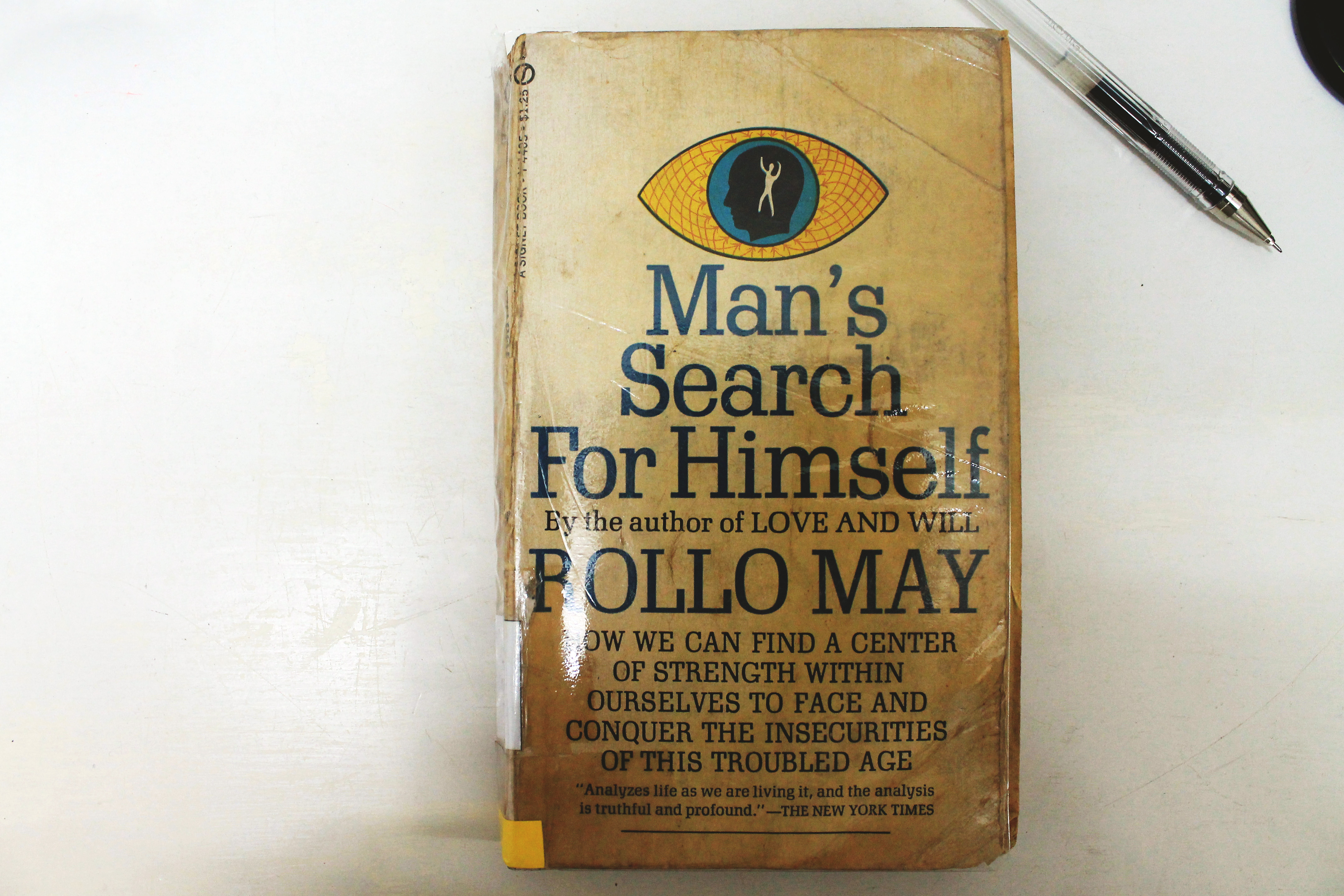
Book Review: Man's Search for Himself


In this book, I noticed parallelisms between Rollo May's insights with those of Erich Fromm, especially on the aspect of freedom and irrational authority. But the difference is, May's style is rather free-flowing and spontaneous as contrasted with Fromm's somewhat repetitive with rigorously referenced writing.

Condemning ourselves is the quickest way to get a substitute sense of worth. People who have almost, but not quite, lost their feeling of worth generally have very strong needs to condemn themselves, for that is the most ready way of drowning the bitter ache of feelings of worthlessness and humiliation. It is as though the person were saying to himself, “I must be important that I am so worth condemning,” or “Look how noble I am: I have such high ideals and I am so ashamed of myself that I fall short.” A psychoanalyst once pointedly remarked that when someone in psychoanalysis berates himself at great length for picayune sins, he feels like asking, “Who do you think you are?” The self-condemning person is very often trying to show how important he is that God is so concerned with punishing him.

May discusses the phenomenon of man's inability to deal with his own condition of being alone, the anxiety that causes one to feel when being confronted with the reality of having to deal with ones own existence within ones own context. The resulting fear, anxiety, and even panic of confronting this reality of being alone, or with people who do not want to face it when they call the state as 'loneliness.'

Loneliness is such an omnipotent and painful threat to many persons that they have little conception of the positive values of solitude, and even at times are very frightened at the prospect of being alone. Many people suffer from “the fear of finding oneself alone,” remarks AndrĂ© Gide, “and so they don’t find themselves at all.
...
And did not Spinoza's refusing to flee from excommunication by his church and community mean the same inner battle of integrity, the same struggle for the power not to be afraid of aloneness, without which the noble Ethics, certainly one of the great works of all time, could not have been written?
...
Man, furthermore, must make his choices as an individual, for individuality is one side of one’s consciousness of one’s self. We can see this point clearly when we realize that consciousness of one’s self is always a unique act—I can never know exactly how you see yourself and you never can know exactly how I relate to myself. This is the inner sanctum where each man must stand alone. This fact makes for much of the tragedy and inescapable isolation in human life, but it also indicates again that we must find the strength in ourselves to stand in our own inner sanctum as individuals.

He draws his insights from occasional tidbits with Kierkegaard, Nietzsche and Kafka, whom he considers to have been influential on his thought with regards to the condition of man. He also integrated key psychodynamic concepts which are essential in the practice of therapy, case analyses, and so on.

I am quite adamant, however on his overemphasis on matriarchal authority, which he blames as being a great factor for the neurosis of his young male patients. This is perhaps due to what he had analyzed based on his practice, but to pay so much blame on matriarchy at the expense of neglecting other factors, I see it to be biased for his part. The only portion on this book that might convince me of impartiality is his statement of considering social factors that would vary as per condition of each patient. Overall, the book is easy to understand and his insights are straightforward with brutal honesty. I can't say that it is rigorously written in academic style, but it is helpful especially for practicing psychologists geared towards the existential-humanistic orientation.

Book Review: The Revolution of Hope: Toward a Humanized Technology


The Revolution of Hope: Toward a Humanized Technology


This book is born out of the conviction that we are at the crossroads: one road leads to a completely mechanized society; the other to a renaissance of humanism and hope. This book is meant to clarify the issues for those who have not clearly recognized our dilemma, and it is an appeal to action. It is based on the conviction that we can find the necessary new solutions with the help of reason and passionate love for life, and not through irrationality and hate. It is addressed to a broad spectrum of readers with different political and religious concepts but sharing this concern for life and respect for reason and reality.

This book, like all my previous work, attempts to distinguish between individual and social reality and the ideologies that misuse and “coopt” valuable ideas for the purpose of supporting the status quo.
– Erich Fromm, in the Foreword

It came as a surprise to me to have found this little book not from the psychology section, but from the philosophy section at the library, with a title which is less discussed compared to his more popular works namely the Sane Society or Escape from Freedom. And it has something unique in it in addition to the resonating themes found from the two aforementioned titles – Hope.

This book begins by looking into the phenomenon of hope, what it is and what it is not. For it is through this notion of hope that Fromm will then connect the crucial issues that affect modern man– the phenomenon of technological advancement and its effects on man. Through the lens of hope, a productive anticipation is based not only towards the future but also by focusing on the present. 

What is it to hope?

Is it, as many think, to have desires and wishes? If this were so, those who desire more and better cars, houses, and gadgets would be people of hope. But they are not; they are people lusty for more consumption and not people of hope.

Is it to hope if hope’s object is not a thing but a fuller life, a state of greater aliveness, a liberation from eternal boredom; or to use a theological term, for salvation, or a political term, for revolution? Indeed this kind of expectation could be hope; but it is non-hope if it has the quality of passiveness, and “waiting for”—until the hope becomes, in fact, a cover for resignation, a mere ideology.
pp.6

This kind of passive hope is closely related to a generalized form of hope, which might be described as hoping for time. Time and the future become the central category of this kind of hope. Nothing is expected to happen in the now but only in the next moment, the next day, the next year, and in another world if it is too absurd to believe that hope can be realized in this world. Behind this belief is the idolatry of “Future,” “History,” and “Posterity,”… I do nothing; I remain passive, because I am nothing and impotent; but the future, the projection of time, will bring about what I cannot achieve.
pp.8

And even if he tackles the phenomenon of hope, Fromm takes a realistic critique of what it actually means to hope, his critique of society and its destructive effects on the individual cannot actually have been truer until today. Scanning through his words makes one realize or re-affirm observations of how alienated people and society had become from the values of what it means to be human instead of being a cog in the machine.


This society produces many useless things, and to the same degree many useless people. Man, as a cog in the machine, becomes a thing, and ceases to be human. He spends his time doing things in which he is not interested, with people in whom he is not interested, producing things in which he is not interested; and when he is not producing, he is consuming.
pp.38

Among the technological society’s pathogenic effects upon man, two or more must be mentioned: the disappearance of privacy and of personal human contact.
pp.45

Man is caught up in the endless entrenchment of cultural mores and technological instruments to the extent that his awareness of what matters to him the most as a human being are either blocked off, forgotten, or no longer given importance which eventually lead to alienation, loss of hope, and dehumanization. But,


…some people, while unconsciously they have turned into things, carry unconsciously a sense of their identity precisely because the social process has not succeeded in transforming them completely into things.
pp.84

Whereas man is supposed to be the benefactor of these instruments that he made and that the inherited values from religions are meant to the actualization of his humanity, the loss of hope and alienation had turned him into a slave of these very things that he constructed to the extent that he does not know and has lost grasp of what matters to him or cannot move beyond what society expects of him, all the while being utterly powerless to change the situation for the better. Two results can occur when hope is shattered: either the loss of dependence to others or destructiveness,


It is not primarily the economic frustration which leads to hate and violence; it is the hopelessness of the situation, the ever repeated broken promises, which are just as conducive to violence and destructiveness.
pp. 21-22

With regards to computer technology, here is an insight which is also found on his other work, The Anatomy of Human Destructiveness where he expanded the concept of Necrophilia even further to the attraction of man to non-living things such as robotics/AI:


One symptom of the attraction of the merely mechanical is the growing popularity, among some scientists and the public of the idea that it will be possible to construct computers which are no different from man in thinking, feeling, or any other aspect of functioning… One cannot help being suspicious that often the attraction of the computer-man idea is the expression of a flight from life and humane experience into the mechanical and purely cerebral.
pp.43
The computer can serve the enhancement of life in many respects. But the idea that it replaces man and life is the manifestation of the pathology of today.
pp.44

This work is divided into the discussion of hope and its various manifestations: faith, fortitude, resurrection, messianic hope and the shattering of hope; the dehumanized society (AD 2000) and the present technological society (during the time the book was published, on 1968); what it means to be human; suggested steps to the humanization of technological society; and a proposed movement.

As a whole, this book is a means of personal re-affirmation especially to those who are becoming increasingly wary of the present times: the increased use of gadgets with the compulsion to use them, the loss of genuine human connectedness in daily life, the mixed effects of technology on daily life alongside its benefits and its threats to human existence i.e. nuclear weapons, the reduction of human beings to instruments of production or objects of consumption/gratification, the loss of humanity by constant bombardment, destruction and humiliation of human life and dignity by it being reduced to headlines, pictures, videos and forms of entertainment, and the list goes on.


They constantly need the stimulus from the outside, be it other people’s chatter, or the sight of movies, or travel and other forms of thrilling consumption excitements, even if it is only a new man or woman as sexual partner. They need to be prompted, to be “turned on,” tempted, seduced. They always run and never stand. They always “fall for” and never get up. And they imagine themselves to be immensely active while they are driven by the obsession to do something in order to escape the anxiety that is aroused when they are confronted with themselves.
pp.12

Erich Fromm’s work is not a feel-good psychology or philosophy book, it is words describing life in the raw, a refreshing and truthful critique of society and its superficiality and hypocrisies, and how it disrespects the individual human being and eventually the whole of humanity. Regardless of what belief, religion, or ideology one has, one can definitely agree that when it comes to human life and dignity, one has to make the conviction that it should not be used as a means to an end.

The critique took almost the entire book, but Fromm suggested a concrete solution, which is far more suited on the American context. Perhaps, this is the weakest point in the book because of its culture-specific dimension.

Another weak point is the lack of directive approach on how to achieve a passionate love for life when it is clear that modern man is faced with a lot of obstacles that are beyond his control. How to achieve the kind of productive hope or love that this book envisions cultivating in man’s heart which would transcend beyond the obvious societal ills discussed is, what I think, the challenge to the reader himself.

04 April 2016

Confidence

18 February 2016

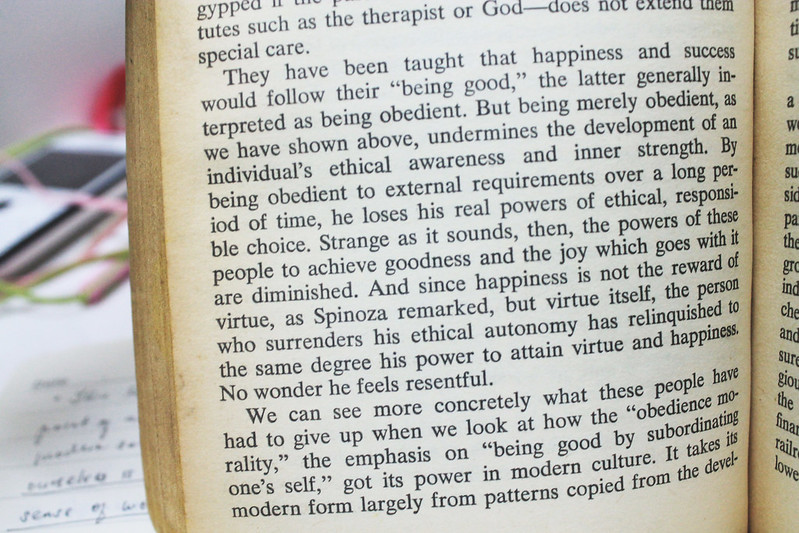
Obedience and Being Good


Social acceptance, "being liked," has so much power because it holds the feelings of loneliness at bay. A person is surrounded with comfortable warmth; he is merged in the group... He temporarily loses his loneliness; but it is at the price of giving up his existence as an identity in his own right.
- Rollo May, Man's Search for Himself

17 December 2015

Sanity

The fact that millions of people share the same vices does not make these vices virtues, the fact that they share so many errors does not make the errors to be truths, and the fact that millions of people share the same form of mental pathology does not make these people sane.
 - Erich Fromm, The Sane Society

08 November 2015

21 August 2015

Working Memory Load and Distraction: Dissociable Effects of Visual Maintenance and Cognitive Control – An Article Review

*Italics are directly quoted from the article.

For this review, I chose an article entitled, Working memory load and distraction: dissociable effects of visual maintenance and cognitive control authored by Nikos Konstantinou, Eleanor Beal, Jean-Remi King and Nilli Lavie. The article was published on the Journal of Attention, Perception and Psychophysics (2014) and was available online on 2 August 2014 at Springerlink. After browsing through some of the contents, I chose the article entitled above because it is related to my current field of interest, cognitive science – which is also considered to be a vital discipline associated with psychology especially in terms of assessment and research.

The study focused not on a single topic, rather on a combination of interrelated factors which it simultaneously explored while drawing insights from previously conducted studies and experiments. Based from the earlier researches and backgrounds on both cognitive psychology and experimental neuroscience, it formulated a number of hypotheses and a series of experiments, the results of which ‘confirmed load theory predictions that provided a novel functional distinction between the roles of working maintenance and cognitive control in selective attention.’ It ‘enhanced the understanding of how working memory and selective attention interact. Working memory load can be either detrimental or beneficial to focused attention, depending on whether maintenance or cognitive control functions are loaded.
In order to understand the back-drop upon where the study is based, I quote from the introduction which I take to be its main premise,
The extent to which selective focused attention allows people to successfully ignore irrelevant distractions is central to our understanding of attention and cognitive control.
It is now well established that the ability to ignore irrelevant distractions is not determined just by the intention to be focused or by the separability of the target and distractor stimuli, but also by the level and type of processing load involved in the current task.
Working Memory (WM) is the main theme of the study. It is a complex system of two functions, namely: [a] Executive cognitive control and [b] Visual maintenance. Executive cognitive control functions are typically revealed in tasks related to verbal working memory, while Visual maintenance functions are exhibited through visual and spatial working memory tasks. It is these two functions of Working Memory (WM) that the study aimed to investigate: how can they be dissociated (differentiated, separated) through the opposite effects of load on selective attention?

Hence, it is through this dissociation (differentiation, separation) of the two functions of Working Memory (WM) that a distinct variable had to be manipulated: load on selective attention. The study therefore takes on an Experimental Approach in order to test its presumed hypotheses stated on the introduction and on the beginning of each experiment— and in order to achieve this, had to First: operationally define the two functions of Working Memory (WM) and in what activity can they be exhibited and measured; and Second: in what manner can load on selective attention be performed on each Working Memory (WM) function, and what specific tasks are to be undertaken (or how the load can be manipulated) in order to find the dissociable effects of load and eventually, distraction.

How Working Memory (WM) had been divided into two functions and how the presumed variable would have effect or effects of dissociating or differentiating the two was based on a theory proposed in Lavie’s load theory which ‘applied a capacity approach to selective attention, while taking into account the role of priority-based Working Memory (WM) control. Load on Working Memory (WM) cognitive control functions also plays an important role. Conditions of high Working Memory (WM) load that reduce its availability to exert priority-based control over the task result in increased processing of irrelevant distractors (due to the reduced distinction between relevant and irrelevant information). Thus, Working Memory (WM) load has the opposite effect on distractor processing to that of perceptual load (e.g., Lavie, 2005; Lavie et al., 2004).’

The experiments on the study were divided into two sets, each set containing two separate experiments. Experiment 1 was divided into 1a and 1b, while Experiment 2 was divided into 2a and 2b— all of which were conducted in a controlled manner.

Experiment 1 was intended to measure the effects of a manipulated load to Visual short-term memory (VSTM) - a Working Memory (WM) function on visual maintenance. For this experiment, the hypothesis of the study was ‘that loading sensory visual representation capacity by manipulating either VSTM maintenance or encoding would lead to reduced distractor.’ Experiment 2 on the other hand, measured the effects of manipulated load on the tasks exhibited by the executive cognitive control-Working Memory (WM) function. The hypothesis for the 2nd set of experiments was also the same as in experiments 1, ‘that increased VSTM load through higher set size would increase demands on visual representation capacity, and thus, lead to reduced distractor processing.

The study is a dynamic exploration of seemingly abstract concepts: working memory, executive cognitive control, visual maintenance, load, distraction. But it was able to quantify and measure and find relationships between the concepts not merely in linguistic terms but on an experimental level which I think is a breakthrough extending to the continuum of the previous studies upon which it was based.

It not only confirmed previous findings (provide a new line of support for the dissociation between Working Memory [WM] functions of storage and cognitive control e.g., Baddeley, 1996; Repovs & Baddeley, 2006; Smith & Jonides, 1999) but extended them, specifically the load theory – to accommodate the effects of different types of Working Memory (WM) load on selective attention.

Based from the results, two conclusions were generated: [1] Loading visual maintenance or encoding by increased set size for a memory sample of shapes, colors, and locations lead to reduced distractor response competition effects; and [2] loading working memory cognitive control with verbal rehearsal of a random letter set led to increased distractor effects.

Aside from sometimes confusing technical terms, I would suggest that the authors to have specifically defined the variables of the study. There is a removal of terms for example, ‘executive cognitive control’ becomes ‘cognitive control.’ There is a tendency for the reader to mistake both terms as corresponding to entirely different concepts. Terms such as ‘distraction,’ ‘load,’ ‘maintenance,’ ‘distractor congruency,’ etc. were all included in the experiments and data analysis and discussion but they were not exactly defined or on what specific context from the previous and present study they are to be understood or how they are made manifest in the experimental activity. Critique aside, the study is a breakthrough.

It is further recommended for future studies like this to utilize brain imaging results that would simultaneously be conducted with the participants during the experiment proper, and the results analyzed and correlated synchronously.

27 July 2015

A Rainbow, A Mushroom and Some New Adjustments

https://www.flickr.com/photos/thepetitemuse/19857024729/
https://www.flickr.com/photos/thepetitemuse/19257078055/


Above are some photos I took lately. At home I maintain two small plots of gardens and it's been raining a lot lately, the grass needed to be trimmed and some mushrooms grew at the lawn. The rainbow was taken yesterday afternoon, Long-tail Baby has a new favorite place which is a shoe rack, and my potted Basil has been blooming with some white flowers.
Back to Top

Labels

Baguio Series (15) art (70) book excerpt (57) essay (36) food (39) ideals (148) insights (97) introspection (35) med school (10) monthly photo snippets (27) notes (31) photography (218) places (127) poetry (1) psychology (43) recipes (9) review (31) science (10) travel (76)

Blog Archive